Netanyahu and the approaching election
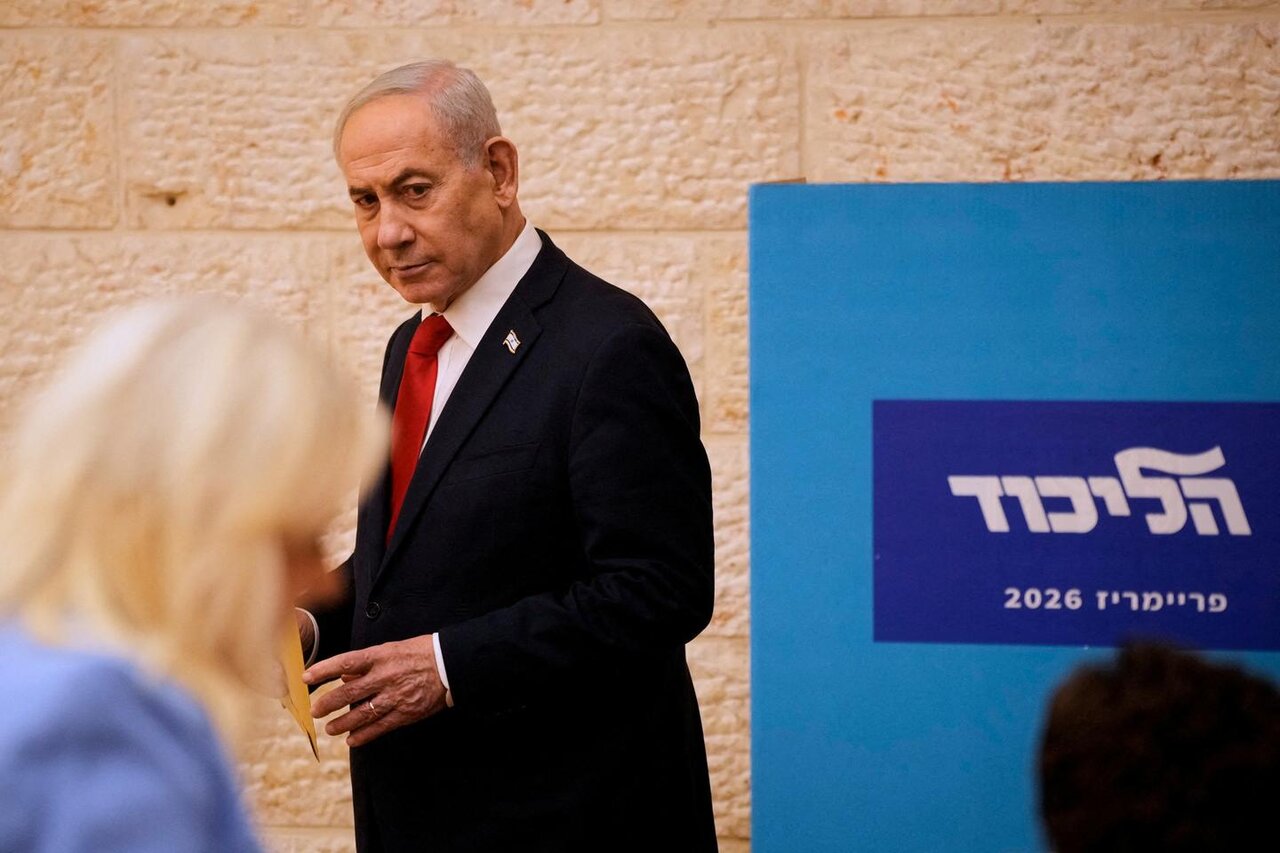
TEHRAN – Benjamin Netanyahu’s election strategy is based on keeping his camp united and avoiding a prison sentence domestically or in The Hague as a war criminal.
Netanyahu is focused on only one issue these days: the next election, which is less than two months away, particularly in light of the figures emerging from public opinion polls.
His concerns have grown following the announcement of the formation of a new right-wing party, Amcha Yisrael (People of Israel) , which could weaken the coalition and threaten the Religious Zionism Party, led by Bezalel Smotrich, by putting its ability to cross the electoral threshold at risk.
At the same time, there is no guarantee that the new right-wing party itself will win seats, which would give the opposition a greater margin for victory.
Although Netanyahu has succeeded in overcoming the sharp decline in the popularity of the Likud Party, which he leads, and of the governing coalition following the October 7 attack, he cannot completely escape responsibility for that failure, despite refusing even to acknowledge partial responsibility.
The opposition, along with a broad segment of the regime’s society, continues to refer to his government as the “October 7 government.”
The more successful the opposition is in bringing the issue to the forefront of public attention, the greater the pressure on Netanyahu, particularly as it repeatedly emphasizes his failure to achieve an absolute victory on all fronts. This is in addition to his inability to bring the genocidal war in Gaza to a decisive military conclusion, as well as his failure to translate what he describes as “military achievements” into political breakthroughs.
By contrast, Netanyahu’s repeated claims of unprecedented successes, including the assassination of leaders of the Axis of Resistance, the occupation of Gaza, Lebanon, and Syria, and strikes against Iran, do not, according to his opponents, give him a clean slate with settlers over the “disaster” that occurred under his watch.
The Gaza and Lebanon fronts also remain unresolved, with no political or military conclusion. The failure appears even more evident in Iran, following the exposure of the Mossad’s failed plan to bring down the Islamic Republic and Iran’s ability to withstand the aggression and rebuild its military capabilities, particularly its ballistic missile arsenal, which succeeded in striking the regime’s targets.
This has kept the home front in a state of anxiety and tension, after Netanyahu spent years promising that he was best positioned to destroy the Iranian threat through cooperation with the United States in a war against Iran.
Another problem facing Netanyahu is the deterioration of relations with the U.S. administration, as well as his personal relationship with President Donald Trump.
Netanyahu’s most recent visit to the White House reflected a cooling in relations between the two sides. During the first term of his presidency, Trump repeatedly praised Netanyahu on social media, called for him to be pardoned more than once, and described Netanyahu’s appearance before the court as a form of injustice rather than a reward for what he had done for the Zionist regime.
Trump also launched an attack on the regime’s president, Isaac Herzog, for failing to respond to his request to pardon Netanyahu over corruption charges. In recent months, however, Trump has offered Netanyahu no comparable support. On the contrary, several statements by Trump and members of his team have been interpreted as casting doubt on Netanyahu’s chances of winning the next election.
The deterioration in relations between the two allies is primarily attributed to U.S. involvement in the illegal war against Iran, which American and Israeli circles have blamed on the pressure Netanyahu put on Trump and the plans he presented to him: plans whose failure was subsequently demonstrated by events on the ground.
Netanyahu, a fugitive wanted for war crimes and crimes against humanity in Gaza by the International Criminal Court, does not give up easily. He is prepared to fight for political survival to his last breath and does not hesitate to use every tool and means available to keep himself in power.
For him, the end justifies the means; what he cannot achieve through deception, tactics, and favors, he seeks to accomplish through more of the same.
He knows that the experience of governmental instability exhausted settlers before the current coalition’s victory and the political battle was settled in his favor.
Netanyahu is seeking to heat up various fronts because his supporters on the right and far right are drawn toward escalation and confrontation and are energized by them.
He therefore plans to keep the aggression fronts active, particularly in Gaza, the occupied West Bank, and Lebanon, as well as Syria, given the latitude for aggressive military operations that the U.S. administration has granted it on these fronts.
If the U.S. were to further expand the regime’s room for maneuver toward Iran, which is unlikely at this stage, Netanyahu would not hesitate to resume the aggression against Iran.
That could provide him with the justification he is looking for to postpone the election because of the war, should his fears of defeat grow.
The West Bank, meanwhile, appears to be the electoral arena most suited to the war criminal and the far right, amid the silence of the U.S. administration.
Netanyahu is weighing his options and examining them with considerable calculation in an effort to control the voters’ agenda, so that his government’s failures are pushed to the bottom of the list, particularly the major failure of the October 7 attack.
The shortest, least costly path in security and political terms, and the one most attractive to his right-wing base, appears to be the West Bank. He can deliberately push the situation there toward more deterioration by providing covert and overt support for settler terrorism and their escalating terror attacks against Palestinians and their property.
This would come alongside political measures and continuing international violations, including efforts to take control of UNRWA facilities, most recently the Qalandia Institute, as well as the events in the village of Qusra south of Nablus and the destruction of a Palestinian monument by one of the governing coalition’s lawmakers. It also includes support for and the establishment of additional settlement outposts in Areas A and B.
Netanyahu has already begun circulating media and political leaks suggesting that the Palestinian Authority could collapse, alongside reports that reservists’ leave has been canceled and that combat battalions are being reinforced in the West Bank out of concern over a “security deterioration.”
These leaks are being directed by Netanyahu and his team to shape settler public opinion, mobilizing the right in Netanyahu’s favor, and pushing the October 7 issue down the list of priorities for the public.
In the Gaza Strip, Netanyahu’s rhetoric has grown increasingly threatening as he searches for a pretext to intensify the genocidal war, even if the excuse is children’s kites, to justify escalation and derail the agreement for the second phase of the ceasefire.
Netanyahu understands that he still has time to escape the trap of political collapse by adopting security, political, and media strategies, and that he can benefit from the fragmentation of his opponents.
Ultimately, however, the election will alter little regarding the regime’s status as the primary source of regional insecurity. The reasoning may hinge less on individual personalities and more on a deeply entrenched strategic and political paradigm.
Both Netanyahu and his main challenger Gadi Eisenkot, share hawkish worldviews. Eisenkot, leader of the Yashar (Straight) Party, pioneered the “Dahiyeh doctrine of disproportionate force”. The regime’s political survival is tied to endless war in the region, which has long fuelled its pariah status and international isolation. In essence, the next prime minister, regardless of identity, will retain a confrontational posture, perpetuating the cycle of tension across West Asia.
Leave a Comment